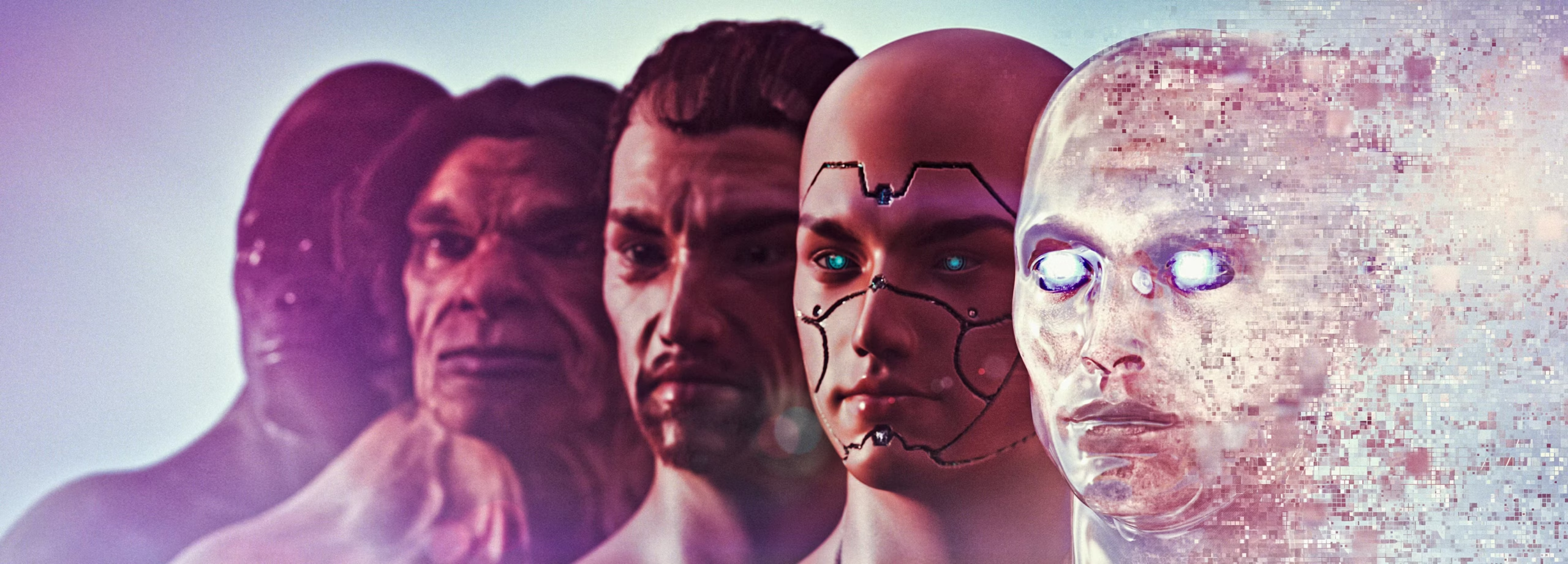
Imagine a world where Homo sapiens suddenly vanished. Not through a dramatic apocalypse of fire and ash, but through a quiet, steady decline perhaps a fertility crisis, a hyper-adaptive virus, or a voluntary departure into simulated realities. The last human footstep fades from the Earth. The lights go out. The concrete crumbles. And in that silence, life does what it has always done: it adapts, mutates, diversifies, and conquers. The question is not whether animals will survive, but what extraordinary forms they will take when released from the pressure of human dominance. This article explores the speculative biology of a future Earth without us outlining the most plausible evolutionary trajectories, the winners and losers of the Anthropocene’s end, and the bizarre creatures that may roam the planet 50 million years from now.
For decades, science fiction has shown post-apocalyptic worlds ruled by mutated monsters or hyper-intelligent apes. However, real evolutionary biology suggests something far more subtle, yet equally astonishing. Without humans, the selective pressures that currently shape animal bodies and behaviors would vanish overnight. Domestication would reverse. Urban ecosystems would rewild. And the great engine of natural selection would accelerate into new territories. To understand future animals without humans, we must first understand the legacy we leave behind our invisible fingerprints on evolution itself.
The Human Shadow on Evolution
Before we erase ourselves, it is vital to appreciate how deeply humans have already altered animal evolution. Even without our physical presence, the genetic and ecological changes we have caused will echo for millions of years. Some of these changes include:
A. Artificial Selection Reversed – Dogs, cattle, chickens, and crops have been bred for human utility. Without human management, these species would undergo rapid de-domestication. Feral dogs would re-form packs, selecting for wolf-like traits. Livestock would face predation pressures, favoring agility and aggression.
B. Island Gigantism and Dwarfism – Human hunting and habitat destruction eliminated many large animals (megafauna). Without us, remaining species on islands might grow larger (gigantism) or smaller (dwarfism) depending on resource availability.
C. Antibiotic and Pesticide Resistance – Bacteria and insects that evolved resistance to human chemicals now possess genetic advantages. In a human-free world, those same genes might become neutral or even harmful, leading to rapid evolutionary flip-flops.
D. Fragmented Populations – Highways, cities, and farmland split animal populations into genetic islands. After humans vanish, these fragments will reconnect, triggering intense gene flow and hybridizations that never occurred before.
E. Novel Contaminants – Plastics, heavy metals, and synthetic hormones have infiltrated every ecosystem. Future animals may evolve enzymes to digest plastic or use heavy metals as structural components (bioremediation evolution).
Thus, the starting point for “future animals without humans” is not a pristine wilderness, but a chemically and genetically scarred planet. Evolution will work with whatever raw material remains.
Timeline of a Human-Free Earth
To visualize animal evolution, we must march through time. The first few centuries are chaotic; the first millennia witness dramatic shifts; and after 10 million years, entirely new body plans emerge.
0 – 500 Years After Humans: The Great Collapse and Release
In the first decades, domesticated animals suffer the most. Dairy cows develop udder infections without milking. Sheep become overgrown with wool, leading to death or rapid selection for self-shedding coats. Grain-fed chickens struggle to forage. However, within 100 years, natural selection culls the helpless. Feral dogs form packs in every continent, hunting deer, rodents, and feral pigs. Cats thrive as solitary hunters, returning to a near-wild state. Rats and mice our constant companions experience a population crash as grain stores rot and cities become dangerous. But they do not disappear; they retreat to forests and adapt to wild diets.
In the oceans, the absence of fishing pressure allows fish populations to explode. Whale species, decimated by industrial hunting, recover slowly. Without shipping noise, marine mammals may develop more complex vocalizations. Coral reefs, bleached by human-induced warming, begin a slow comeback if global temperatures stabilize.
Key animal groups in this period:
-
Urban specialists (pigeons, sparrows, cockroaches) decline but find niches in ruins.
-
Large generalists (deer, wild boar, raccoons) expand explosively.
-
Apex predators (wolves, lions, bears) recolonize former human territories, but face initial prey scarcity.
1,000 – 10,000 Years: The Rewilding Era
By now, most human structures have collapsed into soil. Mega-herbivores like wild cattle (aurochs descendents), horses, and elephants roam vast grasslands across Europe, Asia, and the Americas. Predators evolve to match them. In Africa, lions may face competition from surviving leopards and hyenas, but without poaching, predator numbers stabilize. A fascinating development: the return of large flightless birds. In South America, the rhea family; in Australia, cassowaries; in Africa, ostriches face fewer threats. Without human hunting, some flightless birds might grow even larger, revisiting the niches of extinct terror birds (Phorusrhacidae).
In the oceans, sperm whales and giant squids continue their ancient arms race. Seals and sea lions, no longer hunted for fur or killed as fishery pests, reclaim coastlines. A surprising winner: the octopus. Highly intelligent, short-lived, and adaptable, octopuses may colonize tide pools and coral rubble left by human-caused ocean acidification. Their problem-solving skills already remarkable could lead to tool use and social behaviors never before seen in cephalopods.
Island ecosystems, free from rats and cats introduced by humans, experience explosive adaptive radiation. The Hawaiian honeycreepers, once decimated by avian malaria and habitat loss, may diversify into dozens of new species. Similarly, New Zealand’s remaining birds (kaka, kakariki, weka) could produce giant parrots and predatory herbivores.
Examples of evolutionary experiments in this era:
A. Giant tortoises on formerly inhabited islands (Galapagos, Seychelles) grow even larger due to lack of human collection.
B. Freshwater dolphins (once found in the Amazon and Ganges) expand into rivers where human dams have collapsed, evolving again into new riverine species.
C. Bears in North America separate into ecotypes: coastal bears become specialized marine hunters (repeating the evolution of polar bears), while inland bears become hypercarnivorous or fully herbivorous.
 10 Million Years: The Age of Novelties
At this depth of time, the animals we recognize today would be fossils to the new fauna. Continental drift has shifted landmasses slightly (a few kilometers), but climate change—now driven purely by orbital cycles and volcanic activity has created new deserts, rainforests, and grasslands. The most extraordinary future animals fall into several evolutionary themes.
Theme 1: The Rodent Mega-Fauna
Rats and mice are the most likely candidates to fill large herbivore niches. Rodents have short generation times, high mutation rates, and incredible adaptability. Without human pest control, rodent populations explode and diversify. By 10 million years, several rodent lineages could produce:
A. Giant grazing rats the size of modern tapirs (200–300 kg), with high-crowned teeth for grinding grass, living in herds on open plains.
B. Burrowing super-rats resembling wombats or ground sloths, digging massive tunnel systems that alter soil and water flow.
C. Arboreal squirrel-predators convergent with monkeys, possessing grasping tails and stereoscopic vision, hunting smaller rodents and birds.
The ecological role of deer, antelope, and wild cattle would be partially replaced by these giant rodents. In fact, without humans, the “Age of Rodents” could rival the “Age of Mammals” that followed dinosaur extinction.
Theme 2: Cephalopod Intelligence
Octopuses, squids, and cuttlefish already display intelligence unmatched by most invertebrates. Without human fishing pressure, larger and longer-lived cephalopods may evolve. One possible lineage: the social octopus. Currently, most octopuses are solitary. But in a world without human predation, a species could develop cooperative hunting, den-sharing, and even brood care extended beyond hatching. Given the right selective pressures e.g., competition from intelligent fish or mammals cephalopods could evolve a distributed intelligence network, similar to a hive mind but with individual autonomy.
Such creatures might never build metal tools underwater, but they could manipulate rocks, shells, and even skeletal remains into shelters or traps. They would be the “primates of the sea.”
Theme 3: The Rise of Birds Again
Birds survived the dinosaur extinction. They survived humans. After humans, birds may again dominate the skies and land. Large flightless birds are likely to re-evolve on every continent, but this time with a twist: some may become nocturnal predators. Owls are already superb night hunters. Without artificial light pollution, nocturnal niches expand. Imagine a flightless, long-legged owl-like predator, running down rodents in moonlit grasslands a feathered terror bird reborn.
Additionally, vultures and scavenging birds, once poisoned by human diclofenac and lead, would thrive. Their gut bacteria could evolve to digest plastic and industrial toxins, turning human waste into nutrients. Some seabirds may become entirely pelagic (living on the open ocean), only returning to land to breed in the ruins of coastal cities.
The Ghost of Human Influence: Invisible Evolution
Even without our physical bodies, the evolutionary landscape is forever altered by our indirect actions. Three invisible factors will shape future animals:
-
Isotopic Signatures – Fossilized bones of future animals may contain unique ratios of carbon and nitrogen from human-era pollutants. Paleontologists (if they evolve) would detect a strange global layer of industrial isotopes marking our era.
-
Transmissible Cancers – Humans introduced several contagious cancers into wildlife (e.g., devil facial tumor disease in Tasmanian devils). After human disappearance, evolution may select for resistance, or the cancers may co-evolve into symbiotic transmissible endoparasites.
-
Domestication Genes – Even after countless generations, future animals descended from domesticated ancestors might retain latent genes for tameness. These genes could be reactivated if a new predator-prey arms race favors neoteny (retention of juvenile traits) or reduced fear responses. Curiously, that could make some future animals less “wild” than we imagine.
What About Animals That Depend Entirely on Humans?
Some creatures cannot survive without us. They will vanish within decades, leaving no evolutionary descendants. Examples include:
A. Head lice (Pediculus humanus capitis) – specialized to human scalps.
B. Human body lice – ditto.
C. Bed bugs (Cimex lectularius in domestic populations) – though some wild populations may survive on bats.
D. Certain gut bacteria – evolved specifically for human digestive tracts.
E. Indoor cockroaches – though many outdoor species remain.
Other symbionts, like house mice and brown rats, have wild ancestors and will survive. Similarly, the domestic dog will not vanish; it will revert to a feral, pack-hunting canid, but it will never again be Canis familiaris as we knew it.
Could Any Future Animal Develop Human-Like Intelligence?
This is the most provocative question. Without humans, will another lineage evolve language, technology, and civilization? The answer depends on ecological opportunity and evolutionary luck. Candidates include:
-
Corvids (crows, ravens, jays): Already tool-users with episodic-like memory and social learning. In 50 million years, a corvid lineage could develop cooperative problem-solving and vocal syntax rivaling human speech. Their only limitation is the absence of manipulative digits but a beak and claws can be refined.
-
Parrots: Kea parrots in New Zealand already manipulate objects and solve multi-step puzzles. A ground-dwelling, semi-flightless parrot could evolve grasping feet and enhanced vocal learning.
-
Raccoons and coatis: Procyonids have dexterous paws and curiosity. Without human persecution and roadkill, they could exploit new niches, perhaps forming larger social groups and developing primitive tools.
-
Octopuses: As mentioned, but underwater intelligence faces a fundamental barrier: fire and electricity are almost impossible to develop without dry land. Thus, a cephalopod civilization would remain Stone Age by human standards.
Given the evidence, the most likely “successor” to human cognitive dominance is either a corvid or a parrot. They already possess large brains relative to body size, long lifespans, and complex vocal communication. In a world without humans, these birds could become the planet’s first avian civilization.
Ecological Surprises: Animals That Benefit Most
Some animals that currently struggle under human dominion would become evolutionary superstars. They include:
A. Sharks – Without overfishing and finning, shark populations would explode. They might even re-invade freshwater systems, evolving into riverine apex predators similar to ancient Xenacanthus.
B. Large constrictor snakes – Pythons and anacondas, currently hunted for skins and killed out of fear, would thrive in tropical rewilded areas. They could evolve even larger sizes, perhaps rivaling the extinct Titanoboa (40 feet long).
C. Eusocial insects – Ants, termites, and some bees are already super-organisms. Without pesticides, their colonies could achieve massive sizes. Leafcutter ants might develop agriculture resembling human farming, cultivating specialized fungal gardens for millions of years.
D. Freshwater stingrays – Their flattened bodies and venomous spines make them successful in rivers. Without being killed as “nuisance” animals, they could diversify into dozens of new ray species in the Amazon and Mekong.
E. Hybrid species – Human-introduced invasive species (e.g., cane toads, zebra mussels) will hybridize with native relatives, creating entirely new hybrid lineages. Some hybrids may possess hybrid vigor, outcompeting both parent species.
What About Climate Change After Humans?
Humans have already committed the planet to centuries of warming, even if emissions stopped today. Future animals will evolve in a warmer, more volatile climate. This means:
-
Smaller body sizes (Bergmann’s rule reversed): Warm-blooded animals tend to evolve smaller bodies in warmer climates to dissipate heat. Future mammals may be generally smaller than today’s.
-
Nocturnal and crepuscular activity – To avoid daytime heat, many animals will shift to twilight or night activity. This could favor enhanced night vision, echolocation, and thermal sensing.
-
Desert specialists – Deserts will expand. Animals like camels, kangaroo rats, and fennec foxes will radiate into dozens of extreme arid-adapted species.
-
Loss of polar specialists – Polar bears, Arctic foxes, and penguins (in Antarctica) will face severe habitat loss. In a human-free world, they may go extinct or adapt to subarctic forests but penguins in forests would be bizarre and unlikely.
 The Deep Future: 50 Million Years and Beyond
At 50 million years, the planet looks alien. Plate tectonics has moved continents. The Mediterranean Sea may have closed. A new ocean may be splitting Africa. The animals would be almost unrecognizable. Some speculative yet scientifically grounded predictions:
-
Giant predatory birds ruling the land, with wings reduced to grasping arms (convergent with theropod dinosaurs).
-
Herbivorous rodents with throat pouches for storing food, akin to hamsters but the size of sheep.
-
Flying squirrels that have evolved true powered flight, competing with bats.
-
Ant colonies that have learned to domesticate fungi and aphids, creating underground “farms” visible as large mounds.
-
Deep-sea gigantism extending to squid, with some species reaching lengths of 30 meters, preying on whale calves.
Conclusion: A World Without Us Is Not Empty
The final message is one of resilience. Animals do not need humans. In fact, for most species, human removal would be the greatest liberation since the last ice age. The future animals without humans will not be monsters or mutants they will be the brilliant, surprising products of natural selection operating on the canvas we leave behind. Some will be familiar: wolves, sharks, elephants. Others will be astonishing: tool-using crows, giant octopuses, rat-like tapirs. And perhaps, somewhere in the treetops or ocean depths, a new intelligence will arise, one that never builds skyscrapers or atomic bombs, but nonetheless contemplates the stars.
When the last human artifact crumbles to dust, life will write its next chapter. And that chapter, free of our meddling, may be the most wondrous yet.